Why should I have all the fun?
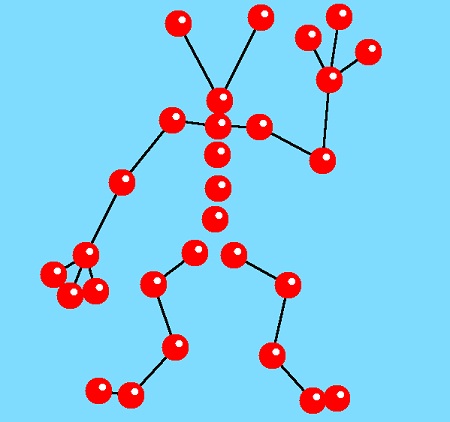
Today I’m posting a little interactive sandbox so you can create your own original Springy Thingy.
Just click on the image below to start:
Because the future has just started
Why should I have all the fun?
Today I’m posting a little interactive sandbox so you can create your own original Springy Thingy.
Just click on the image below to start:
Don’t get me wrong, I love the snow.
But after a few months of this cold New York winter weather, a body longs for just a taste of Spring.
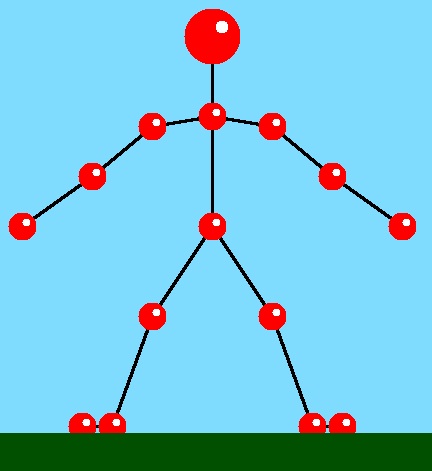
So this evening I made a Springy Guy. You can play with him by clicking on the image below.
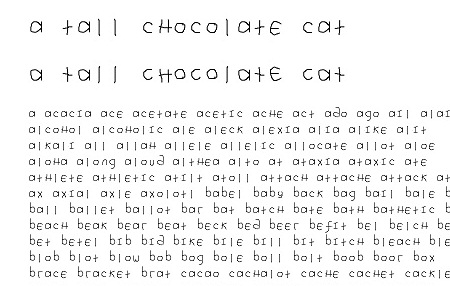
I made a little interactive tool to help you create messages that would work in Vi Hart’s Möbius story world. You can try it by clicking on the image below.
Why a tall chocolate cat? Because that’s the first message that showed up when I tried out this little Möbius message maker.
Besides, why not a tall chocolate cat? 🙂
 |
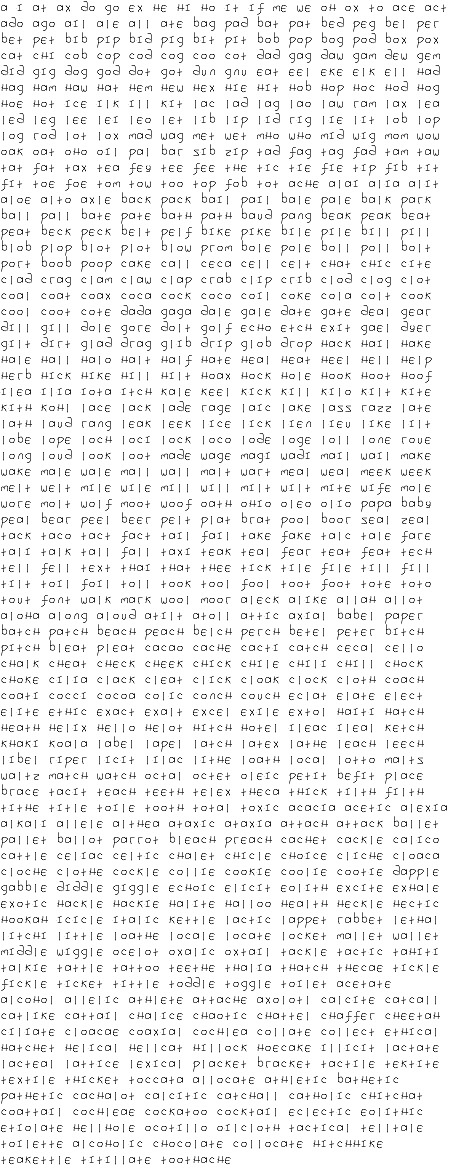
Continuing on my quest to make an interactive playground for creating Möbius stories in the spirit of Vi Hart’s Möbius story: Wind and Mr. Ug, I ran a computer analysis over about 56000 English words, looking for “Möbius words”.
I found 728 words that fit the bill: When “mirror-flipped” upside down, each one still looks like a word (although maybe a different word). Any Möbius story you write has to contain only Möbius words.
Below are the words I found in all their symmetric glory, printed in the Möbius story font. Now we just have to make Möbius stories out of them!
Today’s post, like yesterday’s was inspired by Vi Hart’s Möbius Story: Wind and Mr. Ug, a wonderfully twisted little tale about self-reflection and the unexpected turns that love can take.
I thought would be good to build an interactive tool for telling such stories. My first step is the font below (seen with its mirror image), which I call (in honor of Vi’s tale) the Möbius story font:
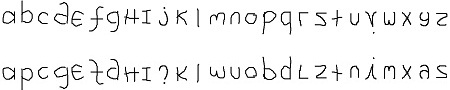
Following on discussions I had with Vi recently, the next step is to build a vocabulary from this font of words that make sense (although maybe very different sense) when read upside down.
Then of course, will come the fun part. Because, in the words of the great Shakespearean actor Sir Edwin: “I don’t want you to get the impression it’s just a question of the number of words… I mean, getting them in the right order is just as important.”
I walked one day on a Möbius strip
Just ’cause I felt like taking a trip.
It seemed so easy, ’til I found
A land where things were turned around
Yes, turned around! Try as I might
I couldn’t tell my left from right
The food they had all tasted funny
The print was backwards on their money!
Now, much as I do like to roam
I just wanted to go home
But I found out to my dismay
The path would only go one way.
They say you can’t go home again,
The world I’d known was gone. But then
“The hell with it,” I said. “Instead,
“Why don’t I just forge ahead?”
So I found another Möbius strip
And started on a second trip
It made no sense I know, and yet
How much wronger could things get?
And sure enough when I’d gone round
That second strip, it seems I found
Another land where things were good
And left to right went like it should
Food was yummy, words looked right
I thought I’d maybe spend the night
Now here I am, still on that trip
To the land beyond the Möbius strip
This was my last evening in Japan, and I was sad to be saying my final goodbyes to my friends before making my way back to my little Ryokon. I was also a bit anxious, because earlier in the week I had gotten thoroughly lost in the narrow winding streets around Kyoto University.
Fortunately, the previous evening my friends had pointed out a small Buddhist shrine that marks the proper turn to take off the main road. Wanting to make sure I had the correct directions this time, I said: “When I see the Buddha, I should take the right turn. Is that it?”
One of my friends looked at me a moment, and then replied: “You know, that’s a good philosophy for life.”
Here in Kyoto
An old temple smiles, as youth
Plays in its shadow
The PAD (pleasure / arousal / dominance) scale by Mehrabian et al provides a nice simple three axis model for classifying all sorts of emotional states, including Anxiety, Depression, Panic, Empathy, Achievement, Extroversion, Arousal Seeking, Loneliness, Emotional Stability, Dependency, Aggressiveness, and Fidgeting.
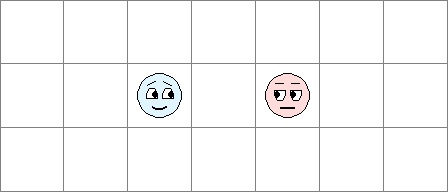
In my recent post about using simple face-only characters to create a story, I used only two of these three dimensions: eyebrows up/down for varying dominance, and mouth frown/smile for varying pleasure. After seeing a lecture today by Marc Cavazza in which he discussed the PAD scale, I realized that it’s easy to add the third (arousal) axis, simply by changing the shape of the eyes.
So I’ve created another version of this program in which I replaced the winking and blinking with eye shapes that evoke different levels of arousal: interested→neutral→bored. I also added a time-line! You can play with the new version by clicking on the image below:
Several years ago I was on the phone with a program officer at the National Science Foundation, and I was describing a possible approach to a topic I’ve discussed here before — “universal programming literacy” — the possibility of everyone learning how to program a computer.
Her response was interesting. She referred to the “five percent who are the math kids”. Basically, she argued, about five percent of the population is interested in how things work, in a way that makes those individuals disposed to become mathematicians or scientists. The other ninety five are just not highly drawn to that way of thinking.
I suppose this idea is analogous to similar ideas about other fields. For example, most of us are exposed to some form of classes about music or art when we are kids. Yet only a small percentage love creating music or art, to the extent that they grow up holding a guitar or a paint brush in their hands, and thereby find their life passion and vocation.
Just in the last day I heard somebody else repeat the phrase “the five percent” in exactly this context, and now I wonder whether it is a given that this is the way things work — that some small percentage of the population are predisposed to becoming scientists, another small percentage are predisposed to becoming musicians, etc. (even in that scenario of course, there will be cross-overs, such as Brian May, who is both lead guitarist for the rock group Queen and an astrophysicist).
We all know examples of siblings who were raised in the same household by the same parents, with essentially the same cultural influences, yet one sibling falls in love with science and the other with, say, literature. This tends to support the “five percent” theory, does it not?