Further research development

I was so proud of myself for getting my research to work yesterday using only the plastic lids of coffee cups. I happily showed my research result to people in the lab, and everybody liked it.

But then today I realized that I don’t actually need even the coffee cop lids. The whole thing works just fine even with virtual coffee cup lids. The physical parts are not really necessary.

I am not sure how I feel about this. On the one hand, it’s great to realize that there is a software-only solution. On the other hand, it was really fun to think I was able to do cutting edge research with cheap plastic coffee cup lids from our local take-out deli.

Oh well, at least the new technique will be eco-friendly.
Unexpected research development

Today I realized I needed a physical object of a certain size and shape for my research. I was thinking that in order to get the shape I wanted, I would need to run a 3D print job.

I really didn’t want to do that because it would be both complicated and expensive. But where was I to get a 3D shape that did exactly what I want?

Pondering this question, I went to our lab kitchen to make myself a coffee.

And that’s when I saw it: It turns out that the plastic coffee lids in our kitchen are exactly the right size and shape for my experiments.

There are other benefits as well: The total cost of materials for a plastic coffee lid is less than a penny.

I felt excited by this discovery, and newly energized to continue my research. In fact, I was so happy, I forgot to drink the coffee.

A kind of time machine

I had occasion today to look back at emails from 2008. It was a very weird experience.

Back then I was having near daily personal and professional conversations with people I have not spoken to for many years. Just reading those emails brought me back to a another time in my life, when my priorities were very different.

The most haunting email exchanges were the ones I was sharing with a close friend who has since passed away. Of course there was no way of knowing back then that tragedy was looming only a few short years away.

We are who we have always been, and yet we are also constantly in motion. Conversations between our past and our current selves can be a kind of time machine — a deeply revealing one — but they are never easy.

I am not sure I always have the courage it takes to hold such a conversation honestly. But I’d like to think I can rise to the occasion.

10 minute VR modeler

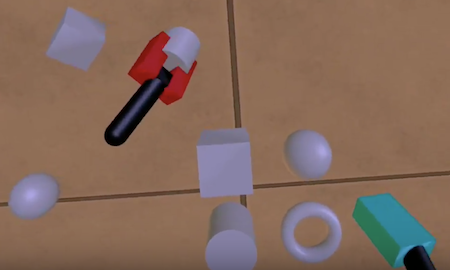
To test my little VR laboratory, I gave myself 10 minutes to implement the very beginnings of a VR geometric modeling system. It’s not much, but it’s a good start.

You can see me trying it out by clicking on the image below.

I am encouraged by the fact that it took so little time to get this far. I am looking forward to building out other capabilities, like snapping objects together, changing colors and textures, designing custom forms and creating animated creatures.

I don’t expect that I will end up with a modeler that will do everything. But I do expect to learn a lot in the process.

Besides, it’s really fun. 🙂

Going for a walk in the Taj Mahal

I have been having so much fun hanging out in my virtualized lab space, that I’m thinking of moving much of my research there. It wouldn’t be a physical move so much as a perceptual one.

After all, I will still be in the lab. Anybody who wants to join me can simply put on a VR headset, grab a pair of controllers, and join in the fun.

In this alternate version of our lab, we will all have super powers. We can create objects simply by waving our hands, change the appearance of the world around us at will, draw animations in the air. Or maybe, just for fun. going for a walk in the Taj Mahal.

Of course we will know that we are not the real world, but that shouldn’t be a problem. When you read a book or see a movie, you also know that what you are experiencing is not actually the real world.

Any sort of virtual experience, be it a book, a play, a film or a computer game, is both less and more than reality. Broadly speaking, these are all forms of literature, tools for sharing and exploring alternate worlds of our imagination.

I wonder what will happen as we get progressively better at blending the serious purpose of collaborative work with the tools of shared immersive experience. Will our collective understanding of reality change as well?

I guess we will find out.

Walls

Forty years ago today
The Wall was taken down
Today’s the anniversary
Of something quite profound

Then three years ago today
(A date that still appalls)
We voted in a guy who vowed
To put up brand new Walls

Why then did we bother
To go through all that fuss?
It makes me wonder what the hell
Is wrong with all of us

The freedom of dreams

As I mentioned the other day, I have been overlaying a virtual world onto a section of this physical world, and creating a one-to-one correspondence between them. Items of furniture in my virtual world are exactly the same locations and dimensions as their physical counterparts, and walls are in exactly the same places in the virtual and the real worlds.

When I put on my Oculus Quest and walk around in this alternate reality, the distinction between the real and virtual worlds starts to blur. Why, I ask myself, can’t I just change the color of a wall here, or manifest a window there, or push up the ceiling to make it higher?

Once such transformations become easy, they seem like second nature. To live this way is simply to bring the freedom of dreams to our waking reality.

This has all been making me rethink my view of dreams. Once technology has become sufficiently advanced, instantaneous dreamlike changes to the physical world around us come to seem like the most natural thing in the world.

Perhaps our dreams have always been a window into our future reality.

Nunchi (when empathy is not enough)

There was an amazing recent article in the NY Times about the Korean concept of “nunchi”. I’ve been thinking deeply about this article.

Nunchi is, to a first approximation, “the subtle art and ability to listen and gauge others’ moods.” A person with “quick nunchi” can accurately read the mood of an entire room full of people.

It’s not a concept that is easy for many Westerners. This is largely because it requires the ability to actually shut up and listen.

The article in the NY Times discusses the difference between nunchi and empathy. You can be very empathetic, yet still misunderstand what is going on around you.

In contrast, a person with quick nunchi is able to correctly perceive whether empathy is even appropriate. This distinction is particularly useful when dealing with people who have narcissistic or sociopathic tendencies.

I’ve been thinking back on my own interpersonal interactions, and realizing that I would be well served by developing my own nunchi. Unfortunately, sometimes empathy is not enough.

Now I want to create worlds

Creating a 3D Web world in VR and sharing it with all of my students was so invigorating that now I want to create more virtual worlds. And that is what I am going to do.

Today I took a tape measure and measured off a section of our lab where there isn’t a lot of foot traffic. I am going to make that part of our lab my experimental “Metaroom”.

I am now building computer graphics versions of the tables and walls in that space, so that whatever I see when I walk around in VR, I will also be able to touch with my actual hands. Also, that way I won’t bump into the furniture! 🙂 Once that’s taken care of I can add whatever I want.

I plan to create floating artworks and creatures that respond to my presence. I also plan to make the world shareable so I can invite my friends to come and play.

After all, this is a Metaroom!