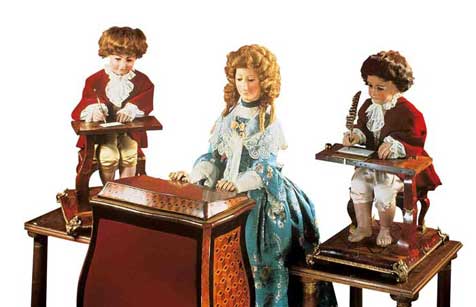
Improvisation

I’m listening to two people improvise together on a piano keyboard. And I am struck, as always on such occasions, by the “conversational” aspect of it. One person introduces an idea, the other takes it and riffs on it, the first person responds with their own variation / counterpoint, and before you know it they are off and running.

When one topic has been exhausted, they begin another, and seemingly in no time they are having an entirely different musical conversation together.

Of course this sounds a lot like what happens when two people start talking to each other. And I don’t think that’s a coincidence. I suspect that we have within us a much deeper instinct for “conversation” than could entirely be due to our species’ relatively recent development of language.

When we see two dogs or cats together, we see similar rhythms of back and forth. The ebb and flow how we spend time together — how we create time together — is a quality of our shared experience that I suspect stems from something deep into our mammalian brains, and perhaps underlies much of our common appreciation of music, as it underlies much that we find enjoyable in life.

Digital 3D recording

There was a time when you couldn’t make endless copies of a song. If you tried to play a recording, then record the copy you’d just played, then record that copy, after a few iterations it would all just turn into noise.

Same thing with images. If you scanned or photographed an image, then printed it, then made another scan, and repeated this a few times, you’d be left with nothing but snow.

This was the analog world we used to live in. Now of course we’re in a digital world, where you can make endless copies of things, because there are lossless digital formats.

Today I was talking to somebody who makes 3D scanners (exotic devices that do 3D scans of physical objects), and I had a sudden inspiration. I was thinking about the 3D printer I have at home, and I realized that if he were to scan an object I had made on my 3D printer, and I tried to 3D print the result, the shape would turn to mush after a few iterations. Just like it used to be for music and pictures.

And then I had a sudden inspiration. I said “Why can’t we do digital 3D printing?” In other words, why can’t we 3D print something losslessly, so that if we scan it, we get a perfect copy, no matter how many times we scan → print → scan → print, and so on.

But how do we do this? Well, let’s think about how much information we’re talking about here. Assume we have a reasonably accurate 3D printer — one that can print things to 0.1 mm accuracy.

Suppose I print a fairly complex object on this 3D printer. Let’s say it’s a famous sculpture that can be described on my computer as a polygonal mesh of 10,000 vertices. That means I need to encode 10,000 points. A point needs three numbers, for its x, y, and z coordinates. Each number needs about 16 bits (for the geeky among you: since one unit is 0.1 mm, 16 bits suffices to give an accurate position up to a length of 6.5 meters).

So we’re talking 16×3 bits × 10,000 points, or about half a million bits.

If our 3D printer can build up a model by depositing melted plastic filament with 0.1 mm accuracy, then we can “wiggle” that filament from side to side as we lay it down, so that it represents a zero bit when it wiggles to the left and a one bit when it wiggles to the right. This wiggling will make the filament take up twice as much room, so we need to make space for 1,000,000 bits.

But at a resolution of 0.1 mm, 1,000,000 bits takes up only 10mm × 10mm × 10mm, or one cubic centimeter.

Which means we can fill our 3D printed model with copies of this one cubic centimeter solid texture, made by our wiggling process. Even a fairly small fragment of the printed model will contain multiple copies of this information. If the printed model is scratched, gauged, cut into pieces or even smashed, we will still be able to recover the 500,000 bits of information that represent the 10,000 vertices that describe the model’s surface.

We don’t need to continue this wiggling all the way to the surface. The model can have a thin shell of solid material, so that if you look at it from the outside you will see only a smooth surface, just like the original sculpture.

I’m going to try some experiments along these lines with my little home 3D printer. If I succeed, then I might just help 3D printing to truly enter the digital age.

A boulder on the tracks

I’m writing this on a train, which is stopped because onto the tracks somebody rolled a very large boulder, which our train has hit. The collision with the boulder has caused sufficient damage to the train (which had been traveling 125 miles per hour) that we passengers now need to transfer to another train.

The conductor has announced that in about half an hour another train will come by, and then we will begin the process of moving everyone.

Sitting here, I am slowly absorbing how fortunate we all are to be alive and well. If our train had gone off its rails, many of us would have been either killed or seriously injured.

The oddest thing is that the conductors say they are quite sure, based on where the event occurred, that the boulder was placed there deliberately (as opposed, say, to having rolled down a hill).

Which leaves me trying to understand the mindset of someone who would roll a giant boulder onto train tracks. Were they just being stupid, or did they actually understand how close they came to causing death or injury to hundreds of people?

Snap together stories

I’m working on a way for people to build stories by snapping together words and phrases. The goal is for this to be collaborative — which means there’s going to be a server side, where the stories that people build together can live.

But first I’m working out the interaction — how you put the pieces together into larger pieces. This effort is very much inspired by the snap-together tiles approach used by the Scratch project at MIT. Except that I’m applying it to natural language.

I hope to have the server side connected soon. Meanwhile you can get a sense of it by clicking on the image below:


Murphy’s blog

Today I usher in a brand new month by welcoming a brand new voice to the blogosphere. Murphy Stein’s new blog “Subject to Change”, which appears to the right in my Blogroll, promises to touch on a very thoughtful range of ideas about the future of social media, games, learning, math, fun, and the exciting discussions that seem to hover in the air all around us these days.

I have had the privilege and pleasure of discussing some of these ideas with Murphy these last few years, and I am glad that he is now sharing them with a wider audience.

Happy reading!

Memorable month

There are months that just seem to glide by, without containing any events of consequence. And then there are months that grab you by the collar, drag you off into a corner, beat you about the head and neck and scream “remember me, damn you!”

I’m not talking about whether a month has been good or bad, only whether it has been memorable. Looking back over this month, I would definitely have to say it has been one of those drag-you-off-into-a-corner kinds of month.

I am not complaining, rather more feeling amused. After all, this is a February we’re talking about — and therefore about as short as a month can be, going by the calendar. We’re not even talking leap month here. Yet for me the last four weeks have been crammed chock full of event and consequence, about as full as as any four weeks can be.

I don’t know whether I would want every month to be so intense. Nonetheless it is interesting, every once in a while, to go through one of these.

Although I do very much hope March will turn out to be more peaceful.

And maybe shorter. 🙂

Oscars

I am writing this just before seeing the 83rd annual Academy Awards. The large field of best picture nominations this year really brings home something odd about the entire endeavor — the idea that there can be a “best” movie in a highly diverse field of high quality movies.

Clearly this is something people want. After all, the Academy has parlayed this desire for one film to triumph into arguably the most potent commercial brand on the planet. People seem to hunger for this sort of competition. Perhaps this particular kind of struggle and outcome puts order into our lives, satisfying some deep primal urge to bring things to some kind of resolution.

Even if it is, in a case like this, a fairly arbitrary resolution. What does it mean to compare a film like “The Social Network” with a film like “The King’s Speech”? In what sense can either of these excellent examples of collective commercial craftsmanship be said to be better than the other?

And yet we rank them, and we will continue to do so. Although I suspect that this entire exhilarating yet more than slightly silly enterprise doesn’t reveal nearly as much about the nature of these movies as it does about the nature of ourselves.

The courage to be funny

On a whim, last night I rewatched the 1968 musical film “Funny Girl”, a highly revisionist take on the great vaudeville comedienne Fanny Brice. In the title role, the young Barbra Streisand won that year’s Academy Award for best actress.

Watching the film now, I was struck by something odd. While Streisand’s singing is spectacular (as always), and she is completely adorable, she’s not very funny. I mean, she’s sort of funny, but not very funny. And this in a role where she is playing a legendary comedienne.

The problem couldn’t be due to a shift in culture in the last four decades. After all, the Marx Brothers are every bit as funny now as they were almost 80 years ago. So I went to YouTube and watched every clip I could find of the actual Fanny Brice, mostly from the 1930s. And man is she funny! Her performances are completely over the top, borderline insane, fearlessly comical.

By complete coincidence, I was having lunch today with my sister, and she mentioned something Jerry Seinfeld had said about his “Seinfeld” co-star Julia Louis-Dreyfus. He pointed out that although she is a beautiful woman, she never lets any desire to look good interfere with her comedy. She’s willing to be as crazed, rubber faced or ridiculous as needed to get the laugh across. Which, he said admiringly, makes her a true comedian.

Immediately, of course, I thought of Lucille Ball, another beautiful woman who was willing to go to the mat for comedy. And it struck me that this was exactly the problem — Barbra wasn’t willing to go to that edge. In fact, she never went anywhere near it. She gave the idea of a person willing to do pratfalls, but as you watch her performance you can always see her signaling to you that it’s just an act.

Of course Barbra Streisand was fighting other battles. She was busy showing the world that a woman who looked ethnically Jewish could also be seen as very beautiful, which was a real battle back then. Similar battles have been fought in other eras over the beauty of other ethnicities — black, hispanic, greek, italian and, in its day, almost any other “outsider” culture. And it’s not just women — Al Pacino fought this battle as well (see the history of the casting of “The Godfather”). So maybe the stakes were too high for Barbra to go to the mat for mere comedy.

But Brice was not interested in fighting for beauty, and she never portrayed herself as one. Beauty, in our society, can itself be a kind of prison. Free of that prison, Brice was free to express herself without restriction, and to be a great comic genius.

Safety meter

I suspect that each of us carries in our head, at every moment, a little meter that indicates “how safe am I now”. I’m not talking here about physical safety, such as the danger that we may be run over by a bus or hit by a stray bullet.

No, I’m talking about something both more subtle and more ineffable — our sense of psychological safety. When we are at dinner with good friends, laughing over a meal and perhaps a bottle of wine, our safety meter tends to read very high. But when we are in a strange country, confused and a little lost, or at a party among strangers where we sense that we are missing key social cues, our safety meter might read considerably lower.

I have had the unnerving experience of seeing my own safety meter plunge, at a moment’s notice, from very high to very low. It can happen when an argument erupts seemingly out of nowhere, or upon suddenly learning something unpleasant about a person you’ve long admired. There is a virtiginous sense of the world shifting, almost as though the floor has disappeared from beneath your feet.

There is nothing we can do about such moments. They will continue to happen no matter how carefully we try to guard the gates of our psyches. The only thing we can do is enjoy those lovely moments in between, the mornings at home sipping our coffee, or out to dinner with good friends, or the wonderful feeling of seeing a play with just the right person.

It is so easy to take such things for granted, but they are more important than you may think. When those other moments come, and your entire psychic world finds itself suddenly plunged into unsafe waters, you will need something to hold onto, to pull you back ashore.

A model of itself

Yesterday’s post was a simple example of a tool to create procedural music. Of course there is much more one could do with this — such as the rich array of work by Toshio Iwai and many others.

But if your goal is to enable crowd-sourced procedural music, where a community collaborates on-line to build a kind of interactive musical world, then things need to be especially intuitive, and people who wish to contribute need to be able to understand quickly and easily the things that were made by other people.

This suggests that in some sense the thing needs to be a model of itself. You have to be able to look at it and say, right away, “oh, I see, this is the structure.”

Which means that the tool set needs to be very carefully chosen. A repetition should look like a repetition, a transposition should look like a transposition, and a theme and variations should look like a theme and variations– immediately, without any need for head scratching.

This is going to require something much more sophisticated than the little toy I posted yesterday. I suspect it will involve zooming in and out — so you can choose to tweak little details or to zoom out and rearrange the entire structure.

I’m not sure what such a community-built musical world construction kit will look like. But I’m pretty sure that when it finally starts to work properly, it will be great fun to play with!